Private Label Sportswear Manufacturer: How to Choose the Right Production Partner
Launching a sportswear line without owning a factory is one of the smartest moves a modern brand can make — but it hinges entirely on the partner you choose. The right private label sportswear manufacturer turns your designs into shelf-ready products under your own label, while the wrong one costs you margin, timelines, and reputation.This guide breaks down what private label manufacturing actually means, why growing brands rely on it, and exactly what to evaluate before you commit to a supplier. Whether you are building a boutique gymwear label or scaling a national sportswear brand, the framework below will help you source with confidence.
What Is a Private Label Sportswear Manufacturer?
A private label sportswear manufacturer produces garments that are sold under your brand name rather than theirs. You control the branding, labeling, and often the design, while the manufacturer handles cutting, sewing, decoration, finishing, and packaging.For apparel businesses, this model removes the biggest barrier to entry: capital-intensive production infrastructure. You get factory-grade output without owning machines, hiring production staff, or managing raw-material supply chains.
Private Label vs. White Label vs. Custom Manufacturing
These terms are often used interchangeably, but they mean different things when you are sourcing:
- Private label: Products are made to your specifications and sold exclusively under your brand. You typically influence design, fabric, and fit.
- White label: A generic, ready-made product is rebranded with your logo. Faster and cheaper, but with limited design control.
- Full custom manufacturing: Everything is built from your tech packs and patterns, offering maximum control at higher MOQs and longer lead times.
Most sportswear brands land somewhere between private label and full custom, adjusting existing blocks and fabrics rather than engineering every garment from scratch.
Why Brands Choose Private Label Sportswear Manufacturing
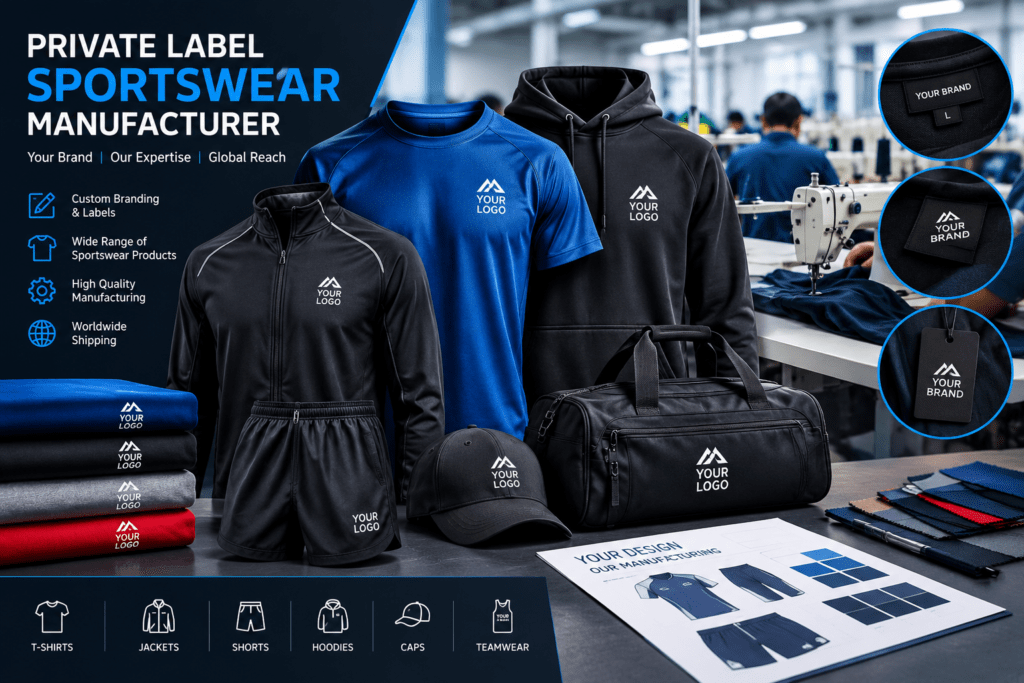
Private label production has become the default path for both new entrants and established labels expanding their catalogs. The benefits are practical and financial.
Faster Time to Market
Because a capable private label sportswear manufacturer already has patterns, fabric sources, and production lines in place, you can move from concept to delivered product in weeks rather than months. That speed matters when you are chasing seasonal demand or testing a new category.
Lower Upfront Investment
Owning production means machinery, warehousing, and a full-time workforce. Private label sourcing converts those fixed costs into a per-unit price, freeing your capital for marketing, product development, and inventory.
Full Brand Control
Unlike buying stock from a wholesaler, a private label lets you own the customer relationship. Your labels, your colorways, your fits, your packaging. The manufacturer stays invisible, and your brand takes the spotlight.
Scalability Without Growing Pains
A strong sportswear manufacturing partner grows with you. Small test runs can expand into large repeat orders without you rebuilding operations each time volume increases.
What to Look for in a Private Label Sportswear Manufacturer
Not every factory that says “yes” is the right fit. Use these criteria to separate a reliable partner from a costly mistake.
Production Capabilities and Specialization
Sportswear is a technical category. Moisture management, four-way stretch, flatlock seams, and compression fits all demand specific expertise. Confirm the manufacturer specializes in athletic apparel rather than treating it as a side line. Ask which product types they run daily — gymwear, training tops, leggings, jerseys, base layers — and request samples in those exact categories.
Minimum Order Quantities and Flexibility
MOQs make or break early-stage brands. A manufacturer with 1,000-unit minimums per style is unworkable if you are launching with five designs. Look for a partner offering realistic MOQs, tiered pricing, and the flexibility to scale quantities as demand grows.
Fabric Sourcing and Quality Standards
The fabric is your product. Ask where they source performance textiles, whether they offer recycled or sustainable options, and how they test for shrinkage, colorfastness, and pilling. A serious private label sportswear manufacturer will share fabric specs and let you approve materials before bulk production.
Customization and Decoration Options
Your ability to differentiate depends on decoration. Confirm which techniques are available in-house — sublimation, screen printing, embroidery, direct-to-film (DTF), 3D embossing, and reflective detailing all create distinct looks. In-house decoration usually means better quality control and shorter lead times than outsourced finishing.
Compliance and Ethical Manufacturing
Retail buyers and conscious consumers increasingly ask about sourcing. Verify labor standards, factory certifications, and quality-management systems. Ethical, compliant production protects your brand from reputational risk and opens doors to larger accounts.
Sampling and Communication
Before any bulk commitment, evaluate the sampling process. How many rounds are included? How fast is the turnaround? Clear communication during sampling is the single best predictor of a smooth production run.
The Private Label Production Process, Step by Step
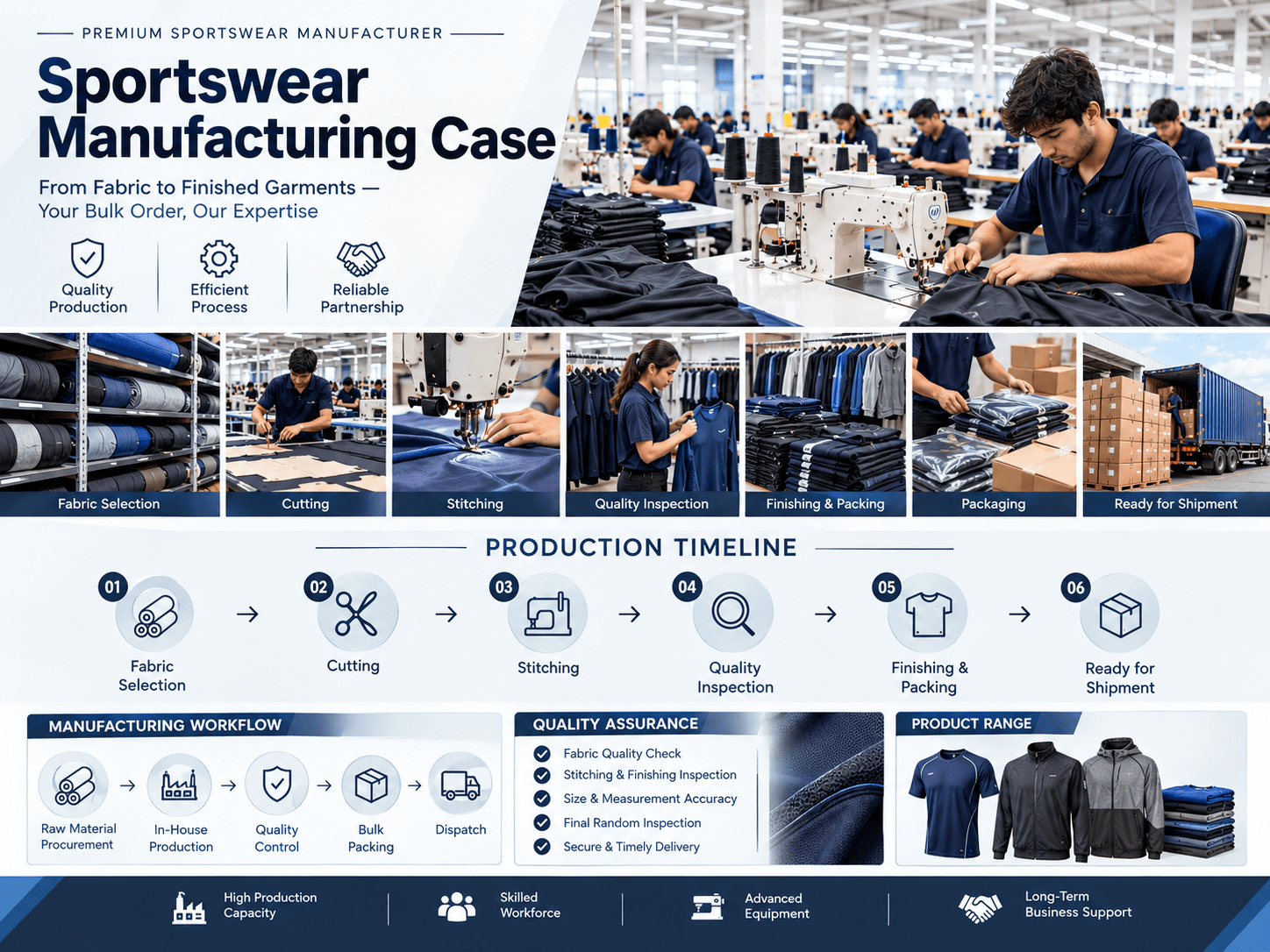
Understanding the workflow helps you set expectations and spot a professional operation.
- Discovery and tech pack: You share designs, measurements, and reference garments. The manufacturer translates these into a production-ready tech pack.
- Fabric and trim selection: You approve materials, colors, and finishing details.
- Sampling: A pre-production sample is made, reviewed, and refined until it matches your vision.
- Bulk production: Once the sample is approved, the full order is cut, sewn, decorated, and finished.
- Quality control: Garments are inspected against agreed standards before packing.
- Labeling and packaging: Your branding, hangtags, and packaging are applied.
- Shipping and delivery: Finished goods are dispatched to your warehouse or fulfillment center.
A transparent partner will keep you updated at each stage rather than going silent after the deposit clears.
How Actic Sports Approaches Private Label Sportswear
Actic Sports works as a private label sportswear manufacturer for brands that want factory-grade quality without the overhead of running production themselves. The focus is on athletic-first construction — performance fabrics, clean finishing, and decoration handled in-house across sublimation, screen printing, embroidery, DTF, 3D embossing, and reflective detailing.
Rather than pushing one-size-fits-all packages, the approach is built around realistic MOQs, structured sampling, and consistent communication from tech pack to delivery. That means emerging labels can test the market with manageable quantities, and growing brands can scale repeat orders on the same reliable production line.If you are evaluating manufacturing partners, the priority should always be fit: the right partner matches your category, your volumes, and your quality bar — not just your budget.
Conclusion
Choosing a private label sportswear manufacturer is a strategic decision, not just a purchasing one. The best partner protects your margins, moves at your pace, and makes your brand look better than you could alone. Vet capabilities, confirm MOQs and quality standards, scrutinize the sampling process, and never skip the reference check.
Get the sourcing right, and production becomes the quiet engine behind your brand rather than a constant headache. When you are ready to build your line, start the conversation with a partner that treats sportswear as a specialty — not an afterthought.
A private label sportswear manufacturer produces athletic apparel that is sold under your brand name. You control the branding, labeling, and often the design, while the manufacturer handles fabric sourcing, production, decoration, quality control, and packaging.
Private label products are made to your specifications and sold exclusively under your brand, giving you influence over design and fabric. White label products are generic, ready-made items simply rebranded with your logo, offering speed and lower cost but far less design control.
Minimum order quantities vary widely by manufacturer and garment type. Some partners require several hundred units per style, while others offer lower, tiered MOQs suited to new brands. Always confirm MOQs per style and per color before committing.
Timelines depend on complexity and order size, but a typical cycle runs from a few weeks for sampling to several weeks for bulk production. A manufacturer with in-house patterns, fabrics, and decoration can move significantly faster than one relying on outsourced steps.
Request samples in your exact product category, review references from past private label clients, and ask about fabric testing, quality-control processes, and factory compliance. A strong sampling round is the most reliable early indicator of production quality.